An outdoor fountain needs more than a cover to make it safely through a freezing winter.
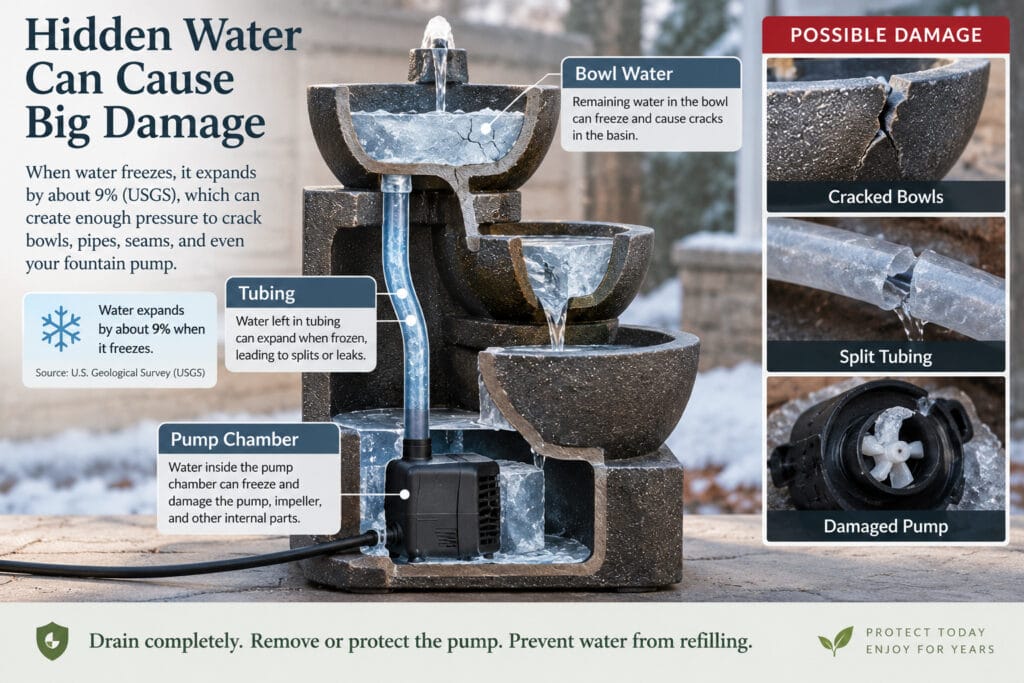
The biggest risk is often the water you can’t easily see—water left inside the pump, tubing, upper bowls, small channels, or low spots in the reservoir. When that water freezes, it expands and can put pressure on fountain surfaces, fittings, tubing, and pump components.
The U.S. Geological Survey explains that the density of ice decreases by about 9% when water freezes. In practical terms, the molecules spread farther apart as liquid water becomes ice. Inside a confined fountain component, that expansion is exactly what you want to avoid.
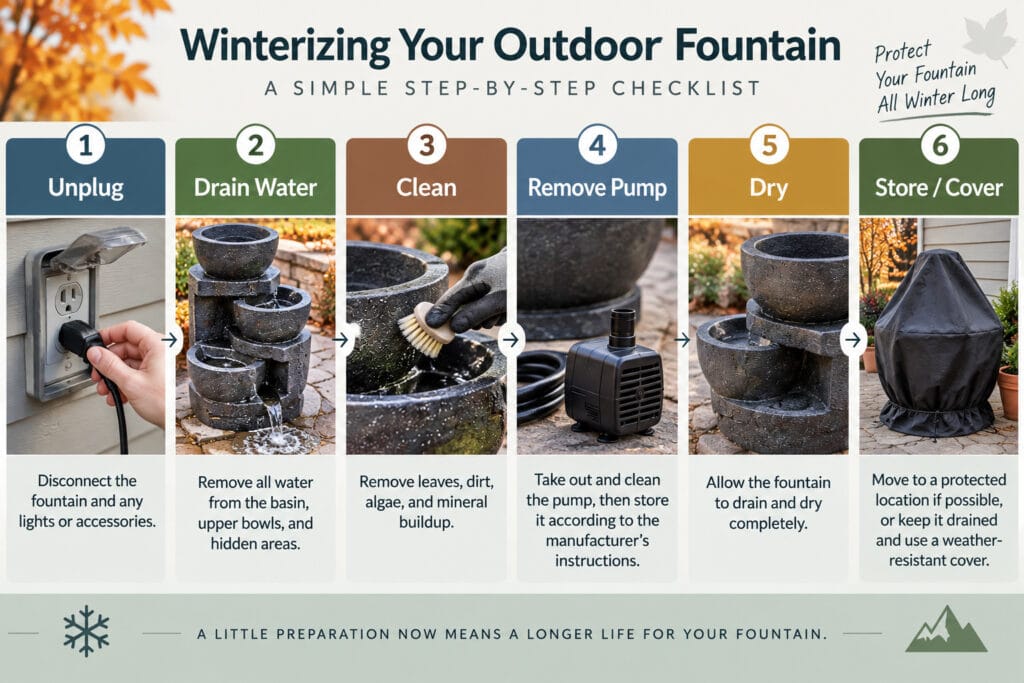
For most small patio and garden fountains, winterizing is not complicated. The basic process is:
Unplug → Drain → Clean → Protect the Pump → Dry → Store or Cover
The exact procedure depends on your fountain’s material, construction, pump design, and local climate, so the manufacturer’s instructions should always take priority.
The important idea is simple:
Winterizing a fountain is less about keeping it warm and more about keeping freezing water out of places where it can cause damage.
Table of Contents
Quick Answer: How Do You Winterize an Outdoor Fountain?
Before freezing weather arrives:
- Unplug the fountain and disconnect any lights or accessories.
- Drain the main reservoir and every upper bowl.
- Check tubing, pump chambers, and other areas where water may remain trapped.
- Remove leaves, algae, dirt, and mineral buildup.
- Remove and clean the pump if the fountain design and manufacturer allow it.
- Store the pump according to its instructions in a frost-free location when required.
- Allow the fountain to drain and dry.
- Move a portable fountain to protected storage when practical.
- If it must remain outside, keep it drained and cover it if recommended.
- Check it during winter so rain, snow, or ice does not collect again.
This general approach is consistent with guidance from major water-feature manufacturers and home-improvement retailers. Aquascape, for example, recommends completely draining its fountain bowls and storing them in a frost-free location when possible. If indoor storage isn’t practical, it recommends draining the bowl and basin, covering them, and preventing water, snow, and ice from accumulating on the cover.
When Should You Winterize an Outdoor Fountain?
Don’t wait until you find ice in the basin.
A practical trigger is when your local forecast begins showing overnight temperatures approaching 32°F (0°C) and freezing conditions are likely to become a regular concern.
One cool fall night does not necessarily mean every fountain needs to be packed away. What matters is whether water in the fountain could actually freeze and remain frozen long enough to create problems.
Think About Climate, Not the Calendar
The right date can be very different across the United States.
| Climate Situation | Practical Approach |
|---|---|
| Winters with regular freezes | Winterize before freezing weather becomes established |
| Mountain or high-elevation climate | Prepare early because nighttime temperatures can drop quickly |
| Mild coastal or Pacific Northwest climate | Watch overnight forecasts and cold snaps |
| Southern or generally frost-light climate | The fountain may operate longer, but be prepared for occasional freezes |
| Fountain already contains ice | Don’t force the pump or strike delicate parts to remove ice |
This is more useful than saying every fountain should be shut down in October or November. A homeowner in Minnesota and one in Southern California clearly do not have the same winter conditions.
And if your owner’s manual specifies a temperature limit or winter-storage procedure, follow the manufacturer’s instructions rather than a general calendar rule.
Why Freezing Water Can Damage an Outdoor Fountain
A fountain can look empty and still contain water.
Common hiding places include:
- pump housings;
- tubing bends;
- upper bowls;
- small water channels;
- recessed fittings;
- decorative cavities;
- low points in the reservoir.
That’s why simply switching off the pump is not the same as winterizing the fountain.
Repeated freezing and thawing can contribute to problems such as cracking, surface deterioration, damaged tubing, loose fittings, and pump damage, depending on how the fountain is constructed.
The USGS notes that ice is less dense than liquid water because its molecular structure is more spread out.
For fountain owners, the practical lesson is more important than the physics:
Don’t focus only on the water you can see. Look for the water that may still be trapped inside the system.
How to Winterize an Outdoor Fountain Step by Step
Step 1: Disconnect the Power
Unplug the fountain before touching the pump, tubing, or water.
If the fountain includes other powered components, such as:
- LED lights;
- a transformer;
- a timer;
- separate electrical accessories;
disconnect them according to the manufacturer’s instructions.
Keep plugs and electrical connections dry while you work.
Never remove or service a submerged pump while it is still connected to power.
Step 2: Drain All the Water
This is the most important step.
Start with the main basin, then work through the rest of the fountain.
Depending on the design, draining may involve:
- opening a drain plug;
- removing a standpipe;
- carefully tipping a small removable basin;
- siphoning or scooping out water;
- using a wet/dry vacuum where appropriate.
Aquascape specifically recommends completely draining its Fountain Bowls and removing the standpipe for winterization.
Multi-Tier Fountains Need Extra Attention
Don’t drain only the bottom reservoir.
Check every tier.
Small amounts of water can remain around:
- outlets;
- bowl edges;
- drain openings;
- internal channels.
After the fountain looks empty, inspect it once more.
Empty-looking and fully drained are not always the same thing.
Step 3: Give It a Seasonal Cleaning
Once the water is gone, remove:
- fallen leaves;
- dirt;
- algae;
- insects;
- loose debris;
- visible mineral deposits.
For many common fountain materials, a soft sponge or soft-bristle brush is safer than abrasive cleaning tools.
Lowe’s recommends identifying the fountain material before choosing a cleaner and warns against harsh cleaners that can scratch or damage fountain surfaces. Its seasonal-maintenance guidance also recommends draining and cleaning the fountain before winter storage.
You don’t need to turn winterization into a full restoration project. The purpose here is to avoid storing the fountain for several months with organic debris or heavy deposits still inside.
For a complete routine covering pump cleaning, mineral buildup, water changes, and normal seasonal care, see our How to Maintain and Clean a Small Water Fountain guide.
Step 4: Remove and Inspect the Pump
For a typical small self-contained fountain, the pump deserves special attention.
If it is designed to be removable:
- disconnect it according to the manual;
- remove debris from the intake;
- inspect the pump housing and impeller area;
- disconnect accessible tubing;
- clean it according to the manufacturer’s instructions.
Lowe’s recommends removing the pump for winter and storing fountain components away from freezing temperatures when possible.
Don’t assume every pump has identical storage requirements, however.
Depending on the manufacturer and pump design, long-term storage instructions can differ. Follow the pump manual if it tells you whether the unit should be stored dry, wet, or in another specific way.
Should You Remove a Fountain Pump for Winter?
For many small outdoor fountains in climates with regular freezes, removing a removable pump is the simpler option.
Even when the basin has been drained, water may remain around:
- the impeller;
- the pump housing;
- fittings;
- short tubing connections.
That’s one reason winter care should include the pump rather than focusing only on the fountain body.
For large pond or waterfall systems, the answer may be different. Those systems can have pumps, plumbing, depth, and winter operating procedures that don’t apply to a small decorative patio fountain.
This guide is primarily for small self-contained outdoor fountains, not large ponds or professionally installed water features.
Step 5: Drain Accessible Tubing
Tubing is one of the easiest places to overlook.
A bend or low spot can hold water even after the fountain reservoir has been emptied.
Disconnect accessible tubing and allow it to drain.
While it is disconnected, look for:
- cracks;
- kinks;
- hardened tubing;
- loose connections;
- mineral deposits.
Finding a worn tube in fall is much easier than discovering it after you’ve filled the fountain again in spring.
Step 6: Let the Fountain Drain and Dry
Don’t immediately seal a freshly drained fountain under a cover.
Give residual moisture a chance to drain and dry, paying particular attention to:
- deep bowls;
- pump compartments;
- decorative crevices;
- tubing connections;
- hollow areas that are accessible.
There is no universal rule that every fountain must sit for exactly 24 or 48 hours. Drying time depends on the design, material, weather, airflow, and how much water remains.
The goal isn’t an arbitrary number of hours.
It’s to avoid knowingly storing a fountain with standing water trapped inside.
Step 7: Store It or Protect It Outdoors
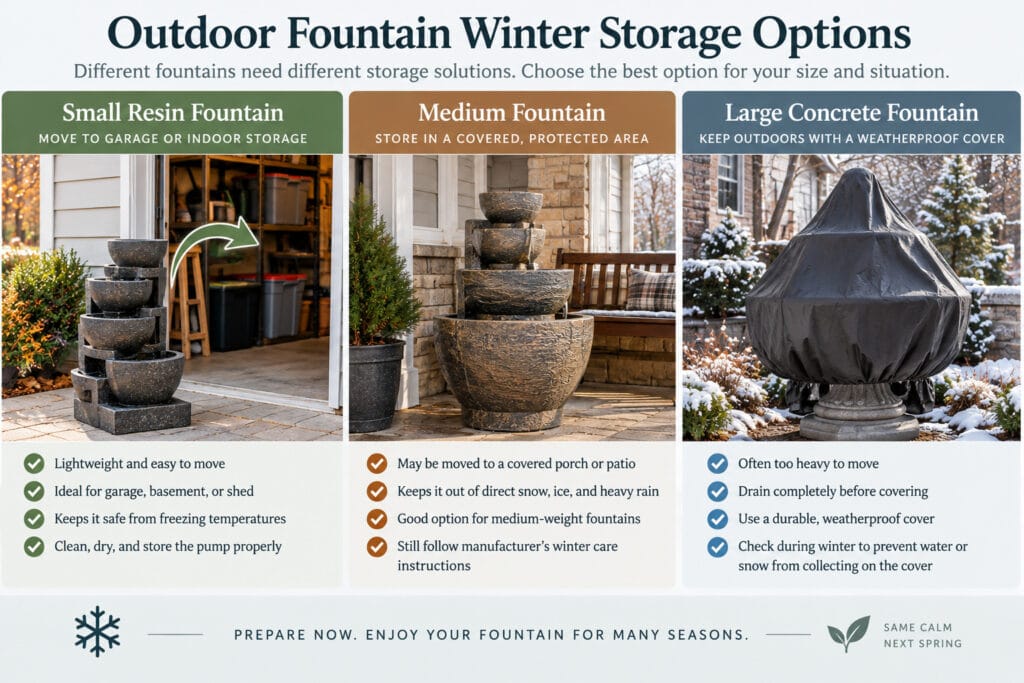
For a small portable fountain, protected storage can make winter care much easier.
Depending on the manufacturer’s requirements, an appropriate location might include a frost-free:
- garage;
- basement;
- storage room;
- other protected space.
Aquascape’s winterizing instructions similarly recommend storing applicable Fountain Bowls in a frost-free location after completely draining them.
Drain Before You Lift
Never judge how easy a fountain is to move while it is still full of water.
Water weighs roughly 8.3 pounds per U.S. gallon, so even a compact fountain can become substantially heavier when filled.
For example:
A 20-pound fountain holding 1.5 gallons of water carries roughly another 12.5 pounds of water before you count decorative rocks or other accessories.
Drain it first.
Then lift from a strong structural area, usually the base—not the top bowl, decorative pieces, tubing, cord, or spout.
If the shape is awkward or the fountain still feels heavy, use two people.
This seasonal-storage advantage is one reason some homeowners prefer smaller resin or composite fountains. For more on portability and dry versus filled weight, see our Best Lightweight Water Fountains guide.
What If the Fountain Is Too Heavy to Move?
Large concrete, cast-stone, ceramic, or multi-tier fountains may need to stay exactly where they are.
In that case, the strategy changes from relocation to water control.
Focus on three things:
Drain completely → Protect vulnerable components → Prevent new water from collecting
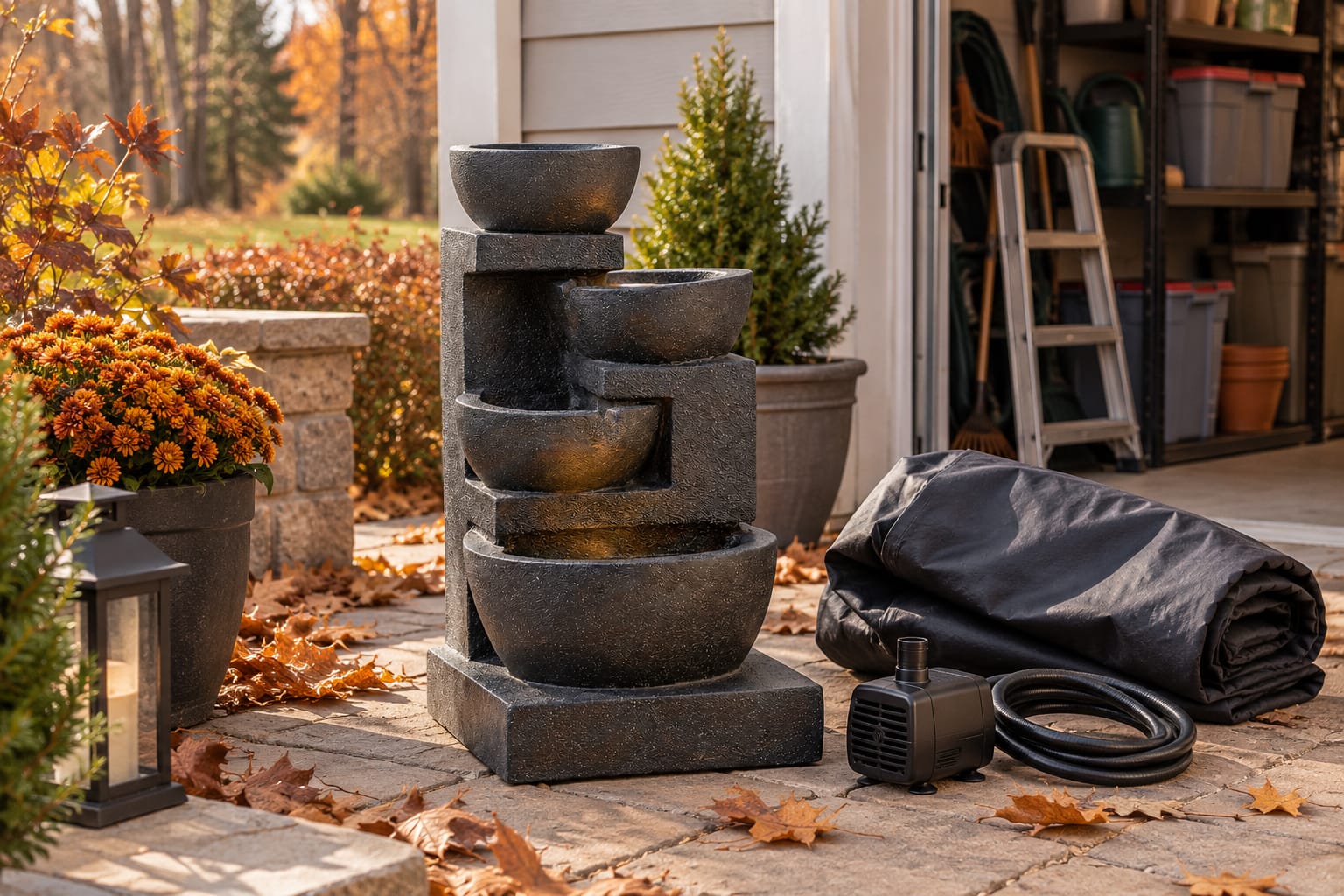
After draining and removing or protecting the pump according to its instructions, use an appropriately sized weather-resistant fountain cover if the manufacturer recommends one.
Aquascape’s guidance is particularly useful here: when a fountain bowl cannot be stored inside, it recommends draining the bowl and basin, covering them, and preventing water, snow, or ice from accumulating on the cover and causing it to sag into the basin.
That last point matters.
A Fountain Cover Does Not Replace Drainage
Putting a cover over a fountain that is still full of water doesn’t solve the freezing problem.
Likewise, if rain or melting snow collects after you’ve winterized the fountain, you can end up with water in the basin again.
During winter, check an outdoor fountain after major:
- rain;
- snowfall;
- freeze-thaw events;
- windstorms.
Make sure the cover remains secure and isn’t funneling water back into the fountain.
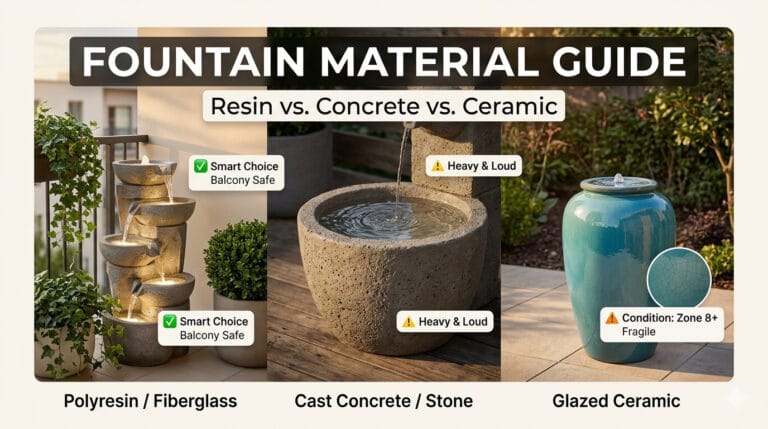
Winter Care by Fountain Material
Material matters, but no single material name tells you everything about winter durability.
Construction, wall thickness, coatings, joints, porosity, and the manufacturer’s design all matter too.
| Fountain Material | Main Winter Concern | Practical Approach |
|---|---|---|
| Polyresin / Resin | Trapped water around seams, cavities or components | Drain thoroughly; move to protected storage when practical |
| Fiberglass / Composite | Water trapped in low points or connected components | Drain and follow model-specific storage instructions |
| Ceramic | Water entering cracks, joints or damaged glazed areas | Protected storage is preferable for portable models when recommended |
| Concrete / Cast Stone | Freeze-thaw exposure and water remaining in bowls or cavities | Drain carefully; protect in place if too heavy to move |

Resin and Polyresin
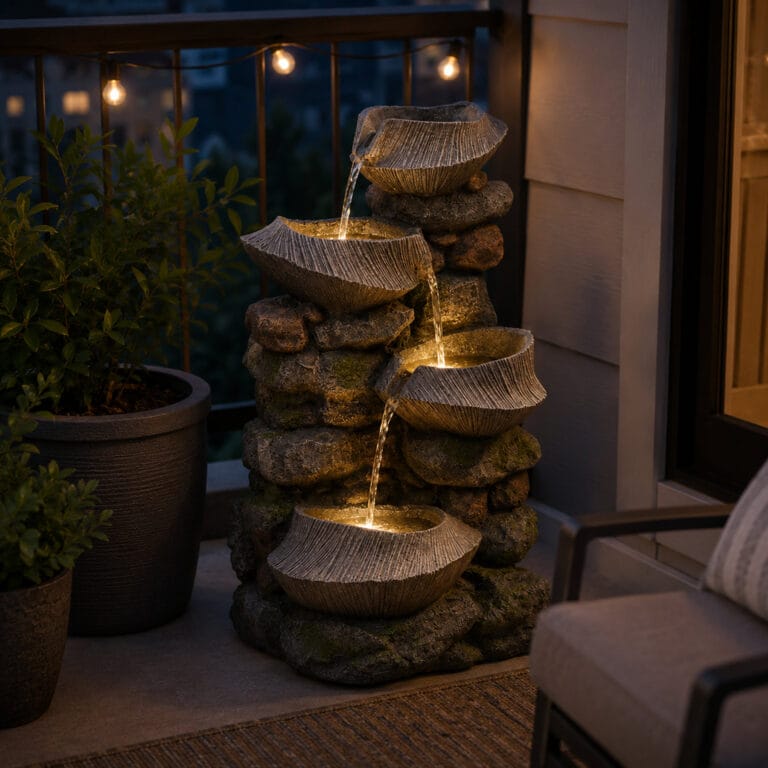
Resin fountains are common in small outdoor spaces because they can provide a stone-like appearance at much lower weight than solid stone or concrete.
That makes seasonal storage easier.
But resin does not automatically mean freeze-proof.
If the manufacturer tells you to drain or store the fountain during freezing weather, follow those instructions.
Fiberglass and Composite
Fiberglass-reinforced and other composite constructions can provide larger forms without the weight of solid masonry.
Their relative portability can be useful for winter storage, but the same rule applies:
don’t rely on the material name alone.
Drain the fountain and follow the specific product instructions.
Ceramic
Ceramic deserves additional care because water can enter cracks, joints, or damaged glazed areas, where repeated freeze-thaw exposure may worsen existing damage.
If a small ceramic fountain can safely be moved to protected storage, that may be preferable to leaving it exposed through a freezing winter.
It also needs careful handling during the move because impact damage is another concern.
Concrete and Cast Stone
Heavy does not mean winter-proof.
Concrete and cast-stone fountains are often too heavy for seasonal relocation, making careful on-site drainage especially important.
Prevent water from remaining in bowls and other collection points, and follow the manufacturer’s specific freeze-weather recommendations.
For a deeper comparison of weight, durability, and use cases, see Resin, Concrete, or Ceramic? Choosing the Best Fountain Material for Small Spaces.
Can I Leave My Outdoor Fountain Outside in Winter?
Sometimes.
But there’s an important distinction:
Leaving the fountain outdoors does not necessarily mean leaving it full and running.
In a climate without meaningful freezing conditions, an outdoor-rated fountain may remain in place year-round if the manufacturer permits it.
Where regular freezes occur, a large fountain may still remain physically outside after it has been:
- drained;
- winterized;
- protected;
- covered when appropriate.
A small portable fountain is often easier to move to a protected location instead.
Lowe’s seasonal guidance takes a similar approach: turn off, drain and clean the fountain for winter, remove the pump, and move everything away from freezing temperatures when practical. For fountains too large or heavy to move, it recommends protecting the fountain with a weatherproof cover after completing the other winterizing steps.
Can You Leave a Small Fountain Running During Winter?
Possibly—but for a small decorative fountain in a climate with repeated freezing weather, seasonal shutdown is usually simpler.
Winter operation creates additional things to monitor:
- ice blocking or redirecting water;
- water level changes;
- pump performance;
- frozen tubing;
- power outages.
The power-outage scenario is easy to overlook.
A fountain may appear fine while water is circulating. But if power stops during freezing weather, water can remain stationary inside exposed components and plumbing.
For most small patio fountains, there is little reason to turn winter operation into a complicated project unless the manufacturer specifically says the fountain is suitable for it.
How Do You Keep an Outdoor Fountain From Freezing?
For a small decorative fountain, the most dependable strategy is usually not trying to heat the water.
Instead:
Remove the water before freezing becomes a problem.
That’s different from managing a large pond.
For a compact self-contained fountain, this sequence is usually much simpler:
Drain → Protect or remove pump → Dry → Store or cover
Avoid improvised heaters or modifications unless the fountain manufacturer specifically approves them.
5 Common Outdoor Fountain Winterizing Mistakes
1. Covering the Fountain Without Draining It
A cover protects the fountain from some weather exposure.
It doesn’t stop the water already inside from freezing.
Drain first. Cover second.
2. Forgetting About Water Inside the Pump
An empty basin doesn’t guarantee an empty pump.
Follow the pump manufacturer’s winter-storage instructions.
3. Draining the Bottom but Forgetting the Upper Bowls
This is especially easy to do with tiered fountains.
Inspect every level separately.
4. Assuming Resin Means Freeze-Proof
Lightweight and weather-resistant are not the same thing as immune to trapped freezing water.
Check the manufacturer’s winter-care instructions.
5. Waiting Until After a Hard Freeze
Winterizing is preventive maintenance.
It works best before the water freezes—not after you discover a solid layer of ice in the fountain.
If the fountain has already frozen, don’t force the pump to operate or strike delicate fountain parts to break the ice.
Outdoor Fountain Winterizing Checklist
Use this before putting the fountain away for the season:
| Winterizing Task | Done |
|---|---|
| Disconnect fountain power | ☐ |
| Disconnect lights/accessories as required | ☐ |
| Drain main reservoir | ☐ |
| Drain every upper bowl | ☐ |
| Drain accessible tubing | ☐ |
| Check hidden low spots for water | ☐ |
| Remove leaves and debris | ☐ |
| Clean fountain surfaces | ☐ |
| Remove and clean pump if appropriate | ☐ |
| Store pump according to its manual | ☐ |
| Allow fountain to drain and dry | ☐ |
| Move portable fountain to protected storage | ☐ |
| Cover fountain left outdoors if recommended | ☐ |
| Check outdoor fountain during winter | ☐ |
One small practical trick: take a photo before disconnecting the pump and tubing.
That gives you a visual reference when you put everything back together in spring. Lowe’s also recommends photographing and labeling fountain components before winter storage to simplify reassembly.
How to Restart Your Fountain in Spring
When freezing weather has passed, don’t immediately fill the fountain and switch it on.
Take a few minutes to inspect it first.
- Remove the winter cover or bring the fountain out of storage.
- Inspect bowls, seams, and surfaces for damage.
- Remove debris.
- Check tubing and fittings.
- Inspect the pump intake and housing.
- Reconnect the pump and tubing correctly.
- Fill the fountain to its normal operating level.
- Only then turn on the pump.
- Watch the fountain for leaks, weak flow, or unusual noise.

Submersible fountain pumps generally rely on water during operation, so don’t intentionally run one dry unless its manufacturer specifically says it supports dry operation.
If the pump runs but the fountain doesn’t circulate properly, see Why Is My Small Fountain Not Pumping Water? (5 Quick Fixes That Actually Work) rather than repeatedly switching the pump on and off.
Frequently Asked Questions
When Should I Winterize My Outdoor Fountain?
Start preparing before regular freezing weather arrives. When local forecasts begin showing overnight temperatures approaching 32°F (0°C), check your fountain’s cold-weather instructions and decide whether it’s time to shut it down. Climate and manufacturer guidance matter more than a fixed calendar date.
Should I Remove My Fountain Pump For Winter?
For many small fountains with removable pumps, removing and protecting the pump is appropriate in freezing climates. Drain and clean it, then store it according to the manufacturer’s instructions. Don’t assume every pump uses the same storage method.
Can I Leave My Outdoor Fountain Outside During Winter?
Yes, in some situations. A heavy fountain may remain outdoors after being completely drained and properly protected. Smaller portable fountains are often easier to move into protected storage. Always follow the manufacturer’s winter-care requirements.
Do I Need To Cover My Fountain For Winter?
Not every fountain has identical requirements, but a weather-resistant cover can help protect a fountain that must remain outside when the manufacturer recommends one. Drain the fountain first. A cover should not be used as a substitute for winterizing.
How Do I Protect An Outdoor Fountain From Freezing?
For most small decorative fountains, remove the water before it can freeze. Drain the fountain and tubing, remove or protect the pump, allow the fountain to dry, and either store it in a protected location or cover it according to its instructions.
Does A Resin Fountain Need To Be Winterized?
It may. Resin construction does not automatically make a fountain immune to freeze damage. If freezing weather is expected, drain the fountain and follow the manufacturer’s winter-storage instructions.
Can I Leave My Fountain Pump Running To Keep The Water From Freezing?
Continuous circulation may work in some specialized water-feature systems, but it should not be assumed to protect a small decorative fountain. Ice, low water levels, and power outages can still create problems. Follow the manufacturer’s cold-weather operating instructions.
Final Recommendation
The easiest way to think about outdoor fountain winter care is this:
Don’t try to protect trapped water from the cold. Remove the trapped water before it freezes.
For most small patio and garden fountains, remember:
Unplug → Drain → Clean → Protect the Pump → Dry → Store or Cover
A lightweight fountain can have a real practical advantage here because, once drained, it may be simple enough to move into protected storage. Larger fountains can often stay in place, but they still need careful drainage and protection against rain, snow, meltwater, and repeated freezing.
Most importantly, do the work before freezing weather arrives.
A short fall shutdown is much easier than discovering a damaged pump, cracked component, or leaking connection when you want to restart the fountain in spring.
For shoppers in cold-winter climates who want something easier to relocate and store each year, our Best Lightweight Water Fountains (Easy-to-Move Small Space Picks) guide explains what to consider when comparing fountain weight, materials, and portability.